

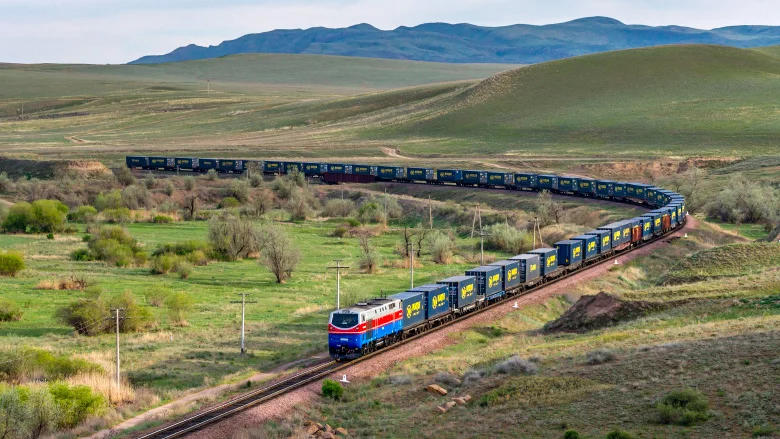
BAKU, Azerbaijan, September 1. The America-Georgia Business Council (AGBC) and the United States-Azerbaijan Chamber of Commerce (USACC) will hold a roundtable with World Bank Regional Director Rolande Pryce on the Middle Corridor and regional connectivity.
“The discussion will examine the Middle Corridor's growing importance as a trade and transportation route connecting Central Asia, the South Caucasus, Türkiye, and Europe. It will also explore opportunities to strengthen regional connectivity, expand trade and investment, and advance economic cooperation among countries along the corridor,” the USACC said.
The World Bank believes that improvements to strengthen the Middle Corridor will help economies to flourish by boosting trade, creating jobs, and spurring entrepreneurship.
“A combination of investments and efficiency measures can reduce travel times along the corridor by half and triple trade flows by 2030,” said the Bank in its 2024 report.
Azerbaijan is actively cooperating with partner countries along the Middle Corridor to strengthen transport connectivity, optimize border-crossing procedures and expand digital information exchange. The Baku International Sea Trade Port, the Baku-Tbilisi-Kars railway, the Alat Free Economic Zone and new logistics centers are significantly enhancing the competitiveness of the route.
In particular, the Baku Port is currently being expanded to increase its cargo handling capacity from 15 million tons to 25 million tons.
One of the most significant gains from reforms along the Middle Corridor has been the sharp reduction in freight transit times. Shipments on the China–Europe route, which once took 38–53 days, now reach their destination in an average of 12 days. This improvement has been driven by the rollout of electronic permitting and digital tools such as e-TIR and e-CMR, real-time cargo tracking, streamlined customs and border procedures, and faster data exchange among government agencies.
The Middle Corridor has a historic opportunity to become a key component of the emerging architecture of Eurasian trade, as global trade becomes increasingly flexible, diversified and multilayered.
The route is gradually evolving beyond a simple transit route connecting two points on the map into a broader economic ecosystem, attracting new trade flows, investment, infrastructure projects and logistics services along its expanding network.
Source: www.trend.az






 scorpion.az