

Agstafa, September 14, AZERTAC
The “Dilbaz” Equestrian Complex in the Agstafa district continues its work to preserve the “Dilbaz” horse, one of Azerbaijan’s national horse breeds, while efforts to further improve its breed composition and increase its population continue consistently.
These efforts are part of the government’s attention to the national equestrian heritage.
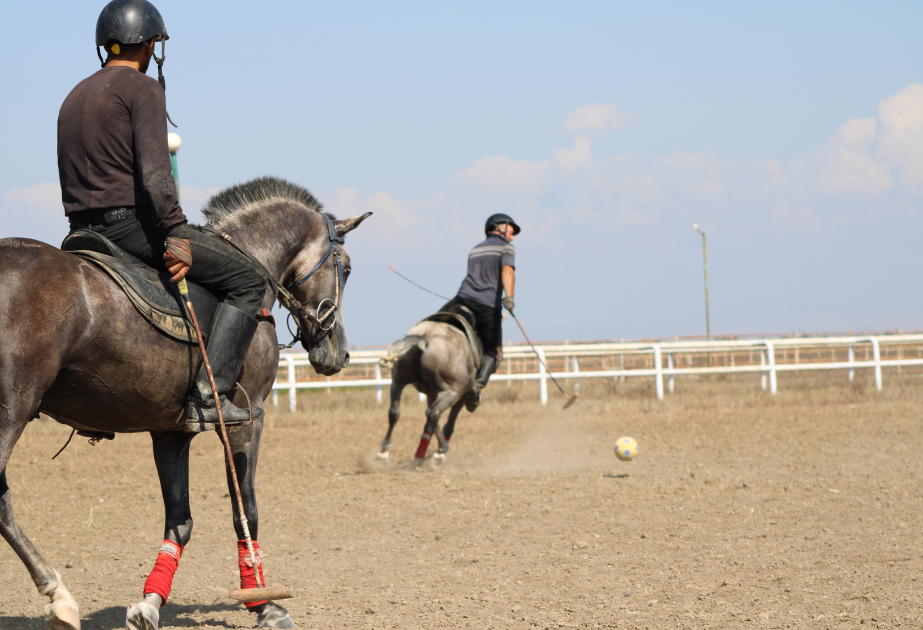
At the moment, the Agstafa facility houses 169 horses. On the one hand, breeding work is carried out here and special care is provided to the purebred horses, while on the other hand, the horses are prepared for sporting competitions. Known for their agility, endurance, and ability to adapt quickly to different climatic and terrain conditions, “Dilbaz” horses have also proven themselves in national sports. The “Zafar” team operating at the complex regularly participates in chovgan competitions and has been among the winners and prize-winners at various tournaments.
Elman Mammadov, head coach of the “Zafar” team, said that “Dilbaz” horses quickly become accustomed to people: “It is easier to work with ‘Dilbaz’ horses. An athlete takes a horse when it is a foal, trains it and raises it. The horse also becomes accustomed to its owner, understands their requirements and behaves accordingly. There are two main national horse breeds in Azerbaijan - ‘Garabagh’ and ‘Dilbaz’. A professional chovgan league is currently being held with the participation of these horses. We are also preparing seriously for the upcoming competitions.”
The physical characteristics, health condition, and breed traits of breeding stallions are kept under constant supervision by specialists.
Shofiq Huseynov, head of the department, noted that the complex has created the necessary conditions for keeping, feeding, and training the animals: “Dilbaz horses are resistant to both cold and heat. We have extensive grazing areas for the mares at the complex. They are brought into the stables in the evening, fed barley and hay, and released back to pasture in the morning. The horses have constant access to water, and we have designated areas for training and running. We stock feed and gather hay to meet the requirements throughout the year.”
Particular attention is paid to the health of the horses in their daily care. Starting in the morning, the animals are checked individually, and their feeding and water intake are monitored. If any illness or other concern is observed, a veterinarian is immediately consulted, while horses brought from outside are placed in a special quarantine section before coming into contact with the other animals.
According to Etibar Mammadov, the facility’s livestock specialist, daily monitoring is important for raising healthy, high-quality offspring: “When we arrive at work in the morning, all the horses are checked first. Attention is paid to their feeding and water intake. If any problem is identified, the veterinarian is informed and, if necessary, the horse is placed in quarantine. Horses brought from outside are also kept in quarantine for one week. The quality of feed, hay, barley, and water must be constantly monitored. All of these are essential for their health.”
The main objective of the “Dilbaz” Equestrian Complex, which has been operating since 1997, is not only to preserve the existing gene pool but also to pass on the characteristic features of these horses to future generations through healthy offspring.
Thus, while a new generation of the breed is being raised at the complex in Agstafa, efforts are also being made to ensure their use in national sports such as chovgan. Both state support mechanisms and the purposeful work carried out at the complex contribute to the preservation of “Dilbaz” horses and their continuation in modern horse breeding.
Source: azertag.az









 scorpion.az