

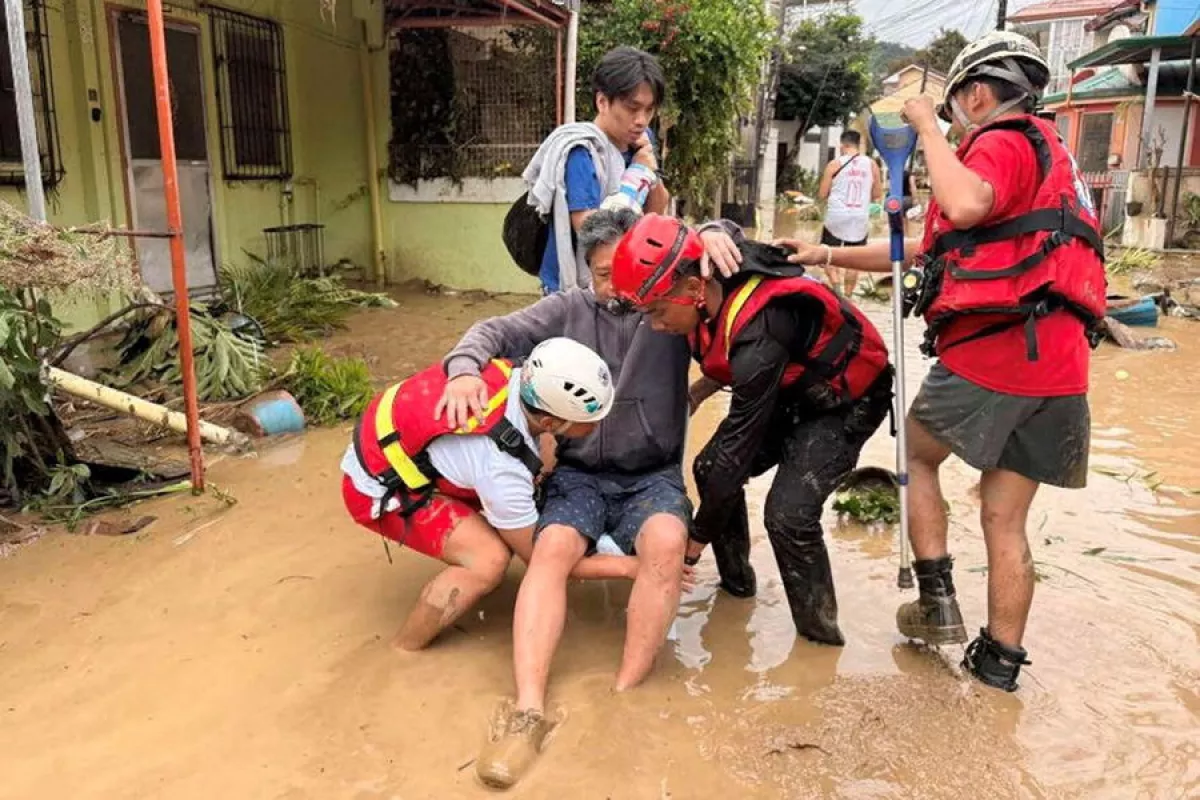
At least 85 people have died and hundreds of thousands have fled their homes after Typhoon Kalmaegi, one of the strongest storms of the year, tore through the central Philippines, authorities reported.
The typhoon, locally known as Tino, caused severe flooding across Cebu, the country’s most populated central island, where at least 49 fatalities occurred. Another 75 people are missing, and 17 have been injured, BBC reports.
Videos from affected areas show residents stranded on rooftops as cars and shipping containers were swept through flooded streets. Among the dead were six crew members of a military helicopter that crashed on Mindanao while aiding relief operations. The Philippine Air Force said communication with the helicopter was lost, prompting a search and rescue operation. Bodies of the pilot and crew were later recovered near Agusan del Sur.
Although the storm has weakened since making landfall early Tuesday, it continues to bring winds exceeding 80 mph (130 km/h) as it moves across the Visayas islands and toward the South China Sea.
Residents of Cebu province are grappling with widespread devastation. “Right now, the rain has completely stopped and the sun is out, but our houses are still filled with mud, and everything inside is in shambles,” said Jel-an Moira Servas, a business owner from Mandaue City. “We don't even know where to start cleaning. I can't even look at it without crying.”
Rafaelito Alejandro, deputy administrator at the Office of Civil Defence, highlighted logistical challenges for rescuers, including clearing debris and vehicles from roads. Volunteer rescuer Carlos Jose Lañas, 19, said, “This is the worst flood I've ever experienced. Almost all the rivers here in Cebu overflowed. Even emergency responders did not expect this kind of scenario.”
Cebu governor Pamela Baricuatro declared a state of calamity, describing the disaster as “unprecedented.” “We were expecting the winds to be the dangerous part, but... the water is what's truly putting our people at risk,” she said.
Most deaths resulted from drowning as muddy floodwaters surged through towns and cities, destroying homes and infrastructure. Boats were used to rescue trapped residents. The Philippines, which averages 20 storms annually, has already endured back-to-back typhoons and a devastating earthquake in recent months, compounding the region’s vulnerability. Kalmaegi is now forecast to move toward Vietnam, already experiencing record rainfall.
By Vafa Guliyeva
Source: caliber.az







 scorpion.az