

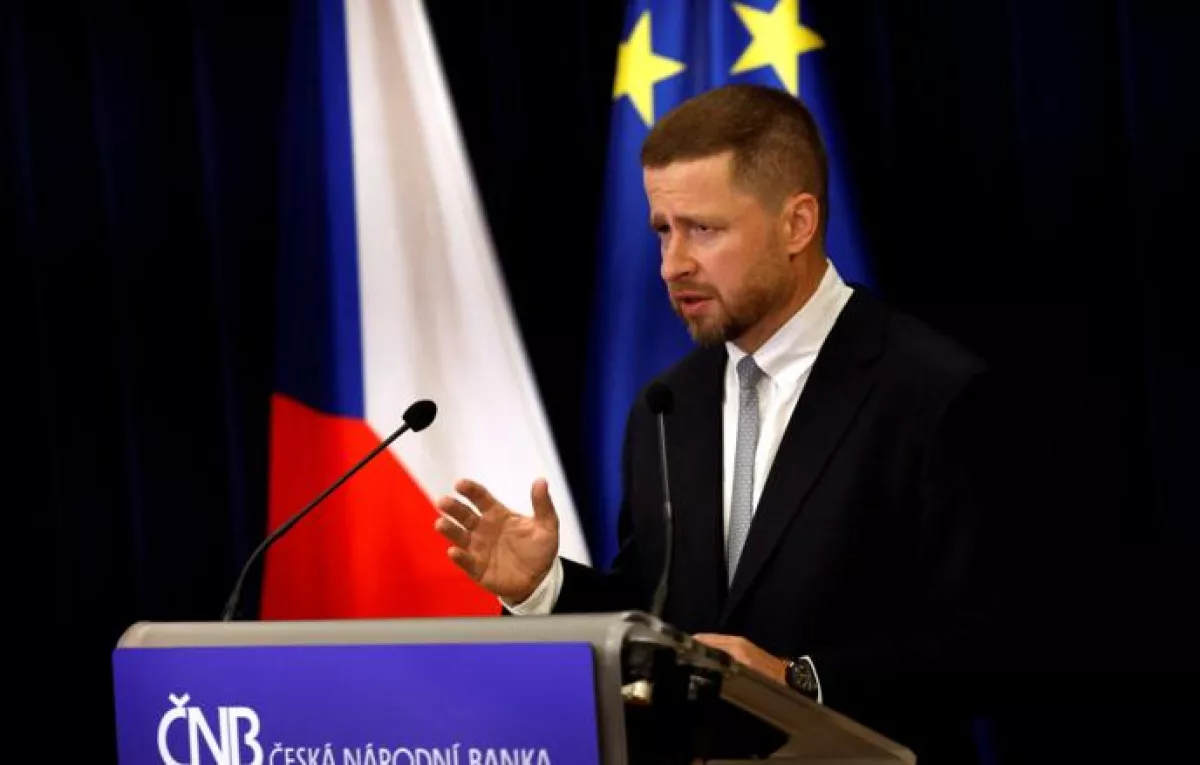
Czech National Bank Governor Aleš Michl has cautioned against adopting the euro too soon, arguing that the Czech economy is not yet sufficiently aligned with the Eurozone and warning that an early move could fuel inflation.
In an interview with the Financial Times, Michl also rejected calls to lower interest rates, saying political pressure should not interfere with the central bank's efforts to maintain price stability.
He criticised Prime Minister Andrej Babiš for advocating lower borrowing costs, arguing that such a policy would undermine the fight against inflation.
Michl said Babiš had become "a catch-all prime minister who follows a Trump-style idea: the cheaper the money, the better," referring to US President Donald Trump's repeated calls for the Federal Reserve to cut interest rates.
He warned that yielding to such pressure could jeopardise price stability in the Czech Republic.
The central bank governor also aimed President Petr Pavel's campaign to adopt the euro, saying the Czech economy had not yet converged sufficiently with Eurozone members despite significant progress since joining the European Union in 2004.
According to Michl, introducing the single currency prematurely could accelerate wage growth and increase other costs, adding to inflationary pressures.
He stressed that the Czech National Bank must remain "independent of both sides" in what he described as a "battle of mistimed ideas" over the country's economic direction.
The comments come amid growing political differences between the pro-European Union President Pavel and the Eurosceptic Prime Minister Babiš. Pavel defeated Babiš in the 2023 presidential election, while Babiš returned to power in December after his ANO party won parliamentary elections.
Last month, the Czech National Bank raised its benchmark interest rate by 25 basis points to 3.75%, marking its first rate increase in four years as it sought to curb wage growth and persistent inflation.
Although headline inflation has remained close to the bank's 2% target over the past two years, the central bank said in June that core inflation, which excludes volatile food and energy prices, had stayed just below 3% without showing signs of easing.
Michl acknowledged that it was "an irony" that he now disagreed with Babiš on monetary policy, having previously served as his economic adviser when Babiš was finance minister.
While President Pavel has publicly defended the independence of the central bank, Michl said the debate over euro adoption had recently produced "no constructive debate, only political noise."
Pavel has argued that because Czech exporters are already deeply integrated into the Eurozone economy, the country would benefit from participating in European Central Bank decision-making rather than remaining outside the bloc.
"The very fact that our economy is significantly interconnected with the Eurozone should lead us to conclude that it is clearly better to be at the table where decisions are made than to sit outside the door and then have to deal with those decisions afterwards," Pavel said at a conference in June.
Although all EU member states except Denmark are required to adopt the euro eventually, there is no fixed timetable. Countries must first meet economic criteria, including maintaining low inflation, sustainable public finances, exchange-rate stability and an independent central bank.
Bulgaria adopted the euro in January, while Hungary has pledged to join the Eurozone by 2030. Michl, however, argued that such developments should not pressure the Czech Republic into abandoning the koruna.
"I like flexible exchange rates, and the appreciation of the [Czech] koruna is a tool for fighting against inflation," he remarked.
By Bakhtiyar Abbasov
Source: caliber.az


 scorpion.az